ZOS Annual Scientific Congress 2026
Virtual Live Stream Access
Live stream Zoom access is restricted to verified and paid delegates to ensure accredited CPD attendance tracking. Direct meeting links and passcodes are delivered automatically to your email alongside your official receipt once approved.
Pre-Congress Activities & Workshops
Register directly for individual pre-congress sessions below. You can attend any pre-event independently without registering for the main congress.
 Pre-Event
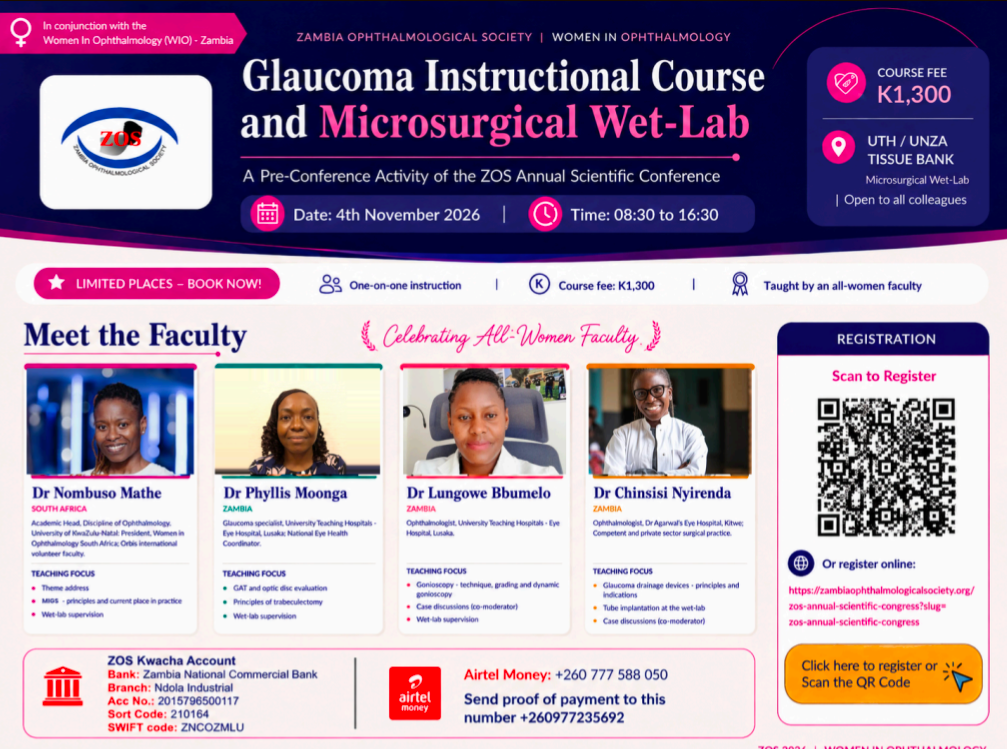
Glaucoma Instructional Course and Microsurgical Wet-Lab
 Pre-Event
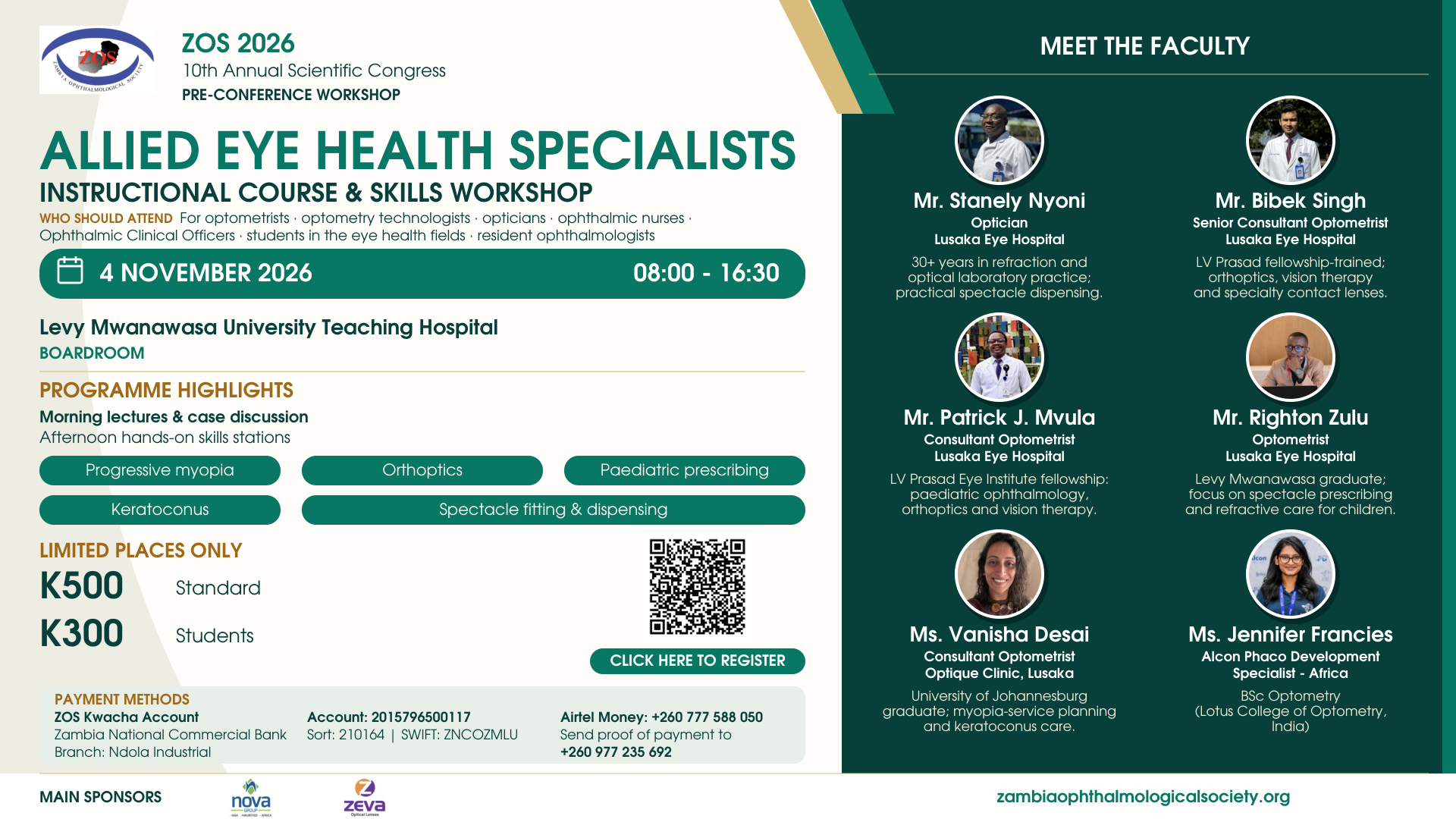
Allied Eye Health Specialists Instructional Course and Skills Workshop
Congress Registration Fees
Take advantage of early bird savings before the fee closing deadlines below. Official registration includes delegate accreditation, CPD points tracking, and scientific sessions.
Early Bird
ClosedSecond Bird
ClosedLate Registration
ClosedOfficial Society Payment Details Kwacha (ZMW)
ZOS Kwacha Account: Bank: Zambia National Commercial Bank (ZANACO) Branch: Ndola Industrial Account No: 2015796500117 Sort Code: 010164 SWIFT Code: ZNCOZMLU Airtel Money: Number: +26 0777 588 050 Send proof of payment to WhatsApp: +260977235692
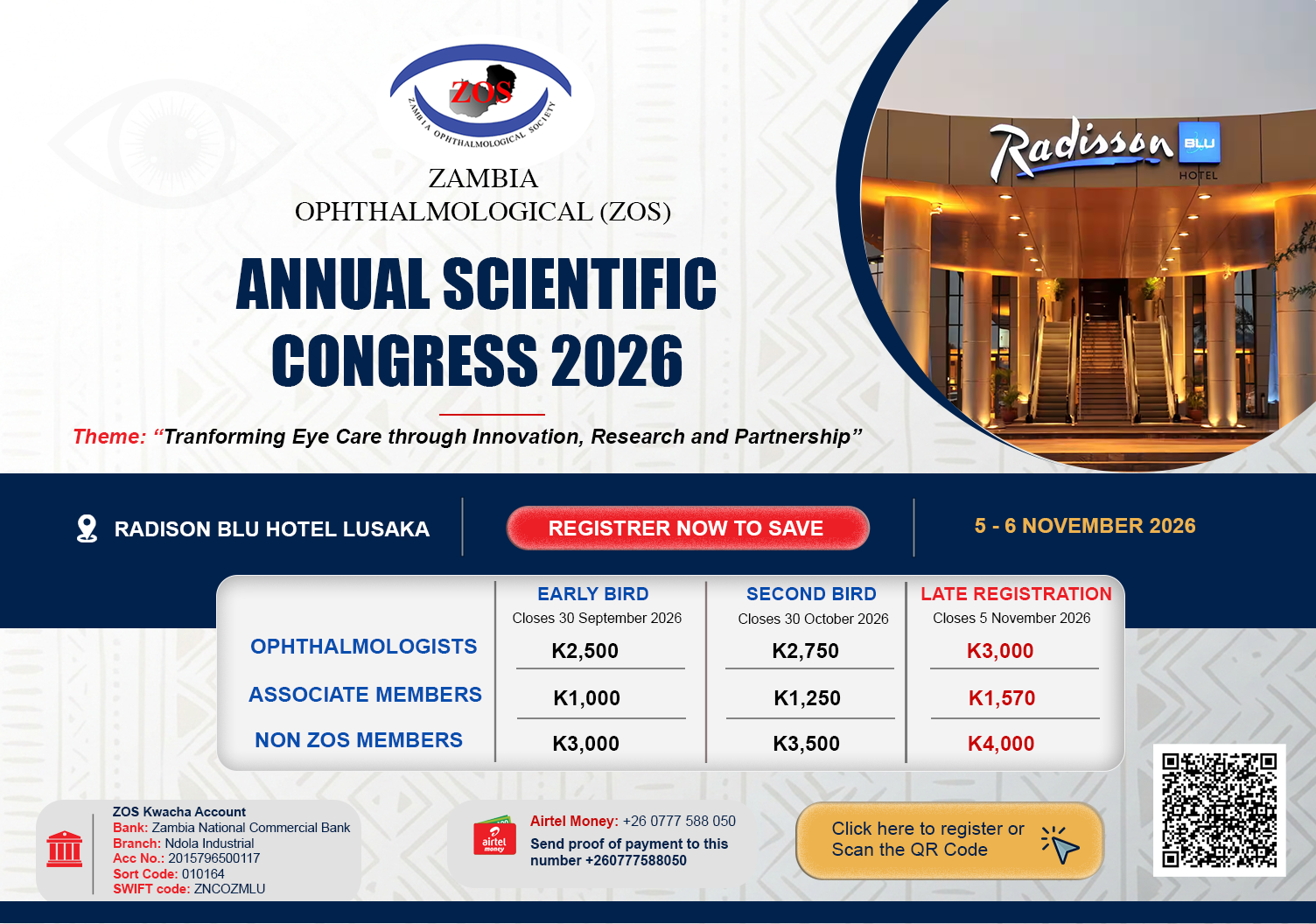
The Zambia Ophthalmological Society annual scientific congress and Annual General Meeting will be held at the Radisson blu hotel in Lusaka, Zambia from 5th to 6th November, 2026 under the theme 'Transforming Eye Care through Innovation, Research and Partnership'.
ZOS_Annual_Scientific_Congress_2026_Programme.pdf
Download the complete itinerary, presenter abstracts, and session handbook in PDF
Presenters & Keynote Speakers
Meet the ophthalmology specialists, clinical researchers, and distinguished guest faculty presenting at this conference.
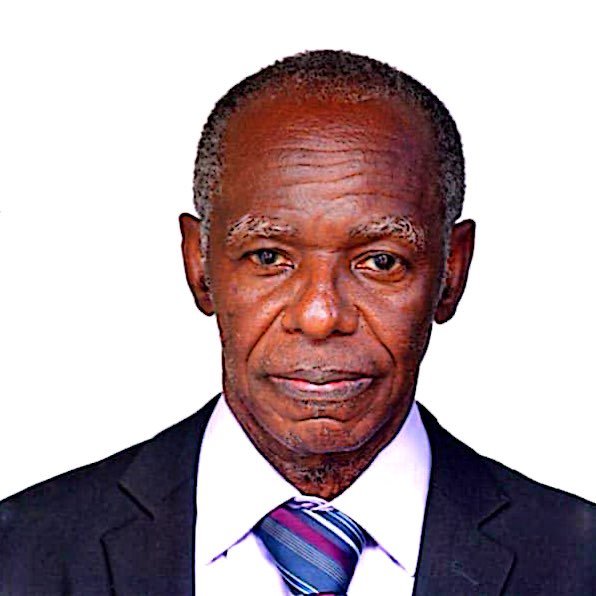
Dr Boateng Wiafe
Keynote speaker
With more than 35 years of experience in eye health care, Dr. Wiafe is recognized as an authority in the development of sustainable eye health care in Africa. He was one of only eight ophthalmologists in Zambia early in his career. Working strategically with the government in Zambia, he encouraged them to take a lead role in the development and implementation of quality eye health care. He also mentored and motivated other doctors to become ophthalmologists. He set new standards in the volume of eye surgeries. In addition, he launched the first primary eye care training course in Zambia. In all of the districts in which he worked, Dr. Wiafe established programs that still serve their communities today, most notably the Lusaka Eye Hospital.
Dr. Wiafe and Victoria Francis co-authored the “Healthy Eyes Activity Book,” a manual for primary schools translated into several languages across the globe. Dr. Wiafe also authored a chapter in the “Glaucoma” textbook by Tarek Shaarawy et al., and he has contributed many articles to the London School of Hygiene & Tropical Medicine’s “Community Eye Health Journal.” In addition, he has lectured and served as an external examiner at the Ophthalmic Training Programme in Lilongwe, Malawi.
Dr. Wiafe served as principal investigator and lead researcher for the first-ever Blindness and Vision Impairment study commissioned by Operation Eyesight in Ghana. He developed a methodology and approach that is reliable and cost-effective, and he worked with the Ministry of Health and associated departments to draw from their expertise and knowledge. The findings of this study has helped Ghana to determine the prevalence and causes of blindness and vision impairment and come up with strategies to mitigate them.
In 2016, Dr. Wiafe was honored by the IAPB as an Eye Health Hero at their General Assembly. This award recognizes exemplary members of the eye health sector from a variety of backgrounds who have emerged as change-makers, innovators, and leaders.
"Tele-consults: Evolution and use of technology, innovation and resources in the provision of quality eye care services in LMICs"

Dr. Nombuso Mathe
She is the Academic Head of Ophthalmology at the University of KwaZulu-Natal and Head of Ophthalmology Services for the KwaZulu-Natal Department of Health, overseeing specialist eye-care services across 11 health districts.
She completed Advanced Glaucoma Fellowship training at Moorfields Eye Hospital in London and holds an MSc in Bioethics and Health Law. Her academic interests span Glaucoma Management, Surgical Education, ethical approaches to clinical training, eye-health systems and governance, and workforce development.
Dr Mathe serves as President of the South African Glaucoma Society, Clinical Chair of the Council for Medical Schemes' National Advisory Committee on Glaucoma, a Founding Member and immediate past President of Women in Ophthalmology South Africa (WOSA), and a member of the Global Advisory Council for Women Leaders in Eye Health. Dr Mathe serves on a number of other provincial and institutional committees within the ministry of health and the University of KwaZulu Natal, and as a National Executive Board Member for Air Mercy Services (AMS). She is also an international volunteer faculty member with Orbis, contributing to surgical training and mentorship across Africa, and holds an appointment of Visiting Professor to Wenzhou Medical University and Eye Hospital.
Her work brings together clinical excellence, academic scholarship, ethical leadership and advocacy to strengthen equitable, sustainable eye care. She is the proud mother to her daughter, and has a passion for farming.
"Beyond Pressure: Tapping the Circadian Code in Visual Survival"

Prof Geoffrey Craig Tabin
Professor of Ophthalmology
Dr. Tabin is the fourth person in the world to reach the tallest peak on each of the seven continents. His passion for mountain climbing directed him to his professional career in eye care. After summiting Mt. Everest, on one of his expeditions, he came across a Dutch team performing cataract surgery on a woman who had been needlessly blind for three years. It was then he understood his life calling.
Tabin graduated from Yale University and then earned an MA in Philosophy at Oxford University on a Marshall Scholarship. From there, he took his interest in moral philosophy and health care delivery to Harvard Medical School where he earned his MD in 1985. After completing an ophthalmology residency at Brown University and a fellowship in corneal surgery in Melbourne, Australia, Dr. Tabin returned to Nepal to work with Dr. Sanduk Ruit.
Tabin and Nepalese eye surgeon Dr. Sanduk Ruit established the Himalayan Cataract Project in 1995 – with a vow to work to eliminate all preventable and treatable blindness from the Himalayan region in their lifetime, a goal, in Tabin’s words, “more audacious than setting out to make the first assent of the East Face of Mount Everest.” Dr. Ruit, whom the Associated Press heralded as the “god of sight” to the world’s poor, and Tabin have proven that hospital quality standards can be applied in impoverished areas devoid of electricity and clean water. Their successful approach to restoring sight and dogged perseverance has made possible what 20 years ago seemed impossible.
The Himalayan Cataract Project has since expanded beyond the Himalayas to encompass Sub-Saharan Africa as well. Dr.Tabin spends a considerable part of the year working abroad throughout the Himalayas and Sub-Saharan Africa. At Stanford his practice focus encompasses surgery and treatment of diseases of the anterior and external eye including cataract and corneal surgery.
Clinical Focus
• Cornea and External Diseases Specialist
Professional Education
• Residency: Michael Reese Hospital (1988) IL
• Board Certification: American Board of Ophthalmology, Ophthalmology (1997)
• Fellowship: Royal Victorian Eye and Ear Hospital (1995) Australia
• Residency: Brown University Division of Ophthalmology (1994) RI
• Residency: University of Colorado General Surgery Residency (1986) CO
• Medical Education: Harvard Medical School (1985) MA
"Keynote presentation"
Program & Scientific Schedule
Explore the comprehensive timetable, lecture sessions, symposiums, and networking intervals.
Registration
Chairperson: Organising Committee. Delegate check-in, badge pickup and congress pack collection.
Tele-consults: Evolution and use of technology, innovation and resources in the provision of quality eye care services in LMICs
Chairperson: Secretary General – ZOS. Keynote Speaker address on telemedicine in low- and middle-income countries.
Keynote Address
Chairperson: Secretary General – ZOS. Keynote presentation by Prof Geoffrey Tabin (Co-founder, Himalayan Cataract Project; Professor of Ophthalmology and Global Medicine, Stanford University).
Beyond Pressure: Tapping the circadian code in vision survival
Chairperson: Secretary General – ZOS. Keynote address exploring circadian biology, neuroprotection and visual survival.
Plenary Discussion
Chairperson: Secretary General – ZOS. Questions, answers and discussion on Session 1 Keynote presentations.
Tea Break
Chairperson: Organising Committee. Morning tea, refreshments & exhibition exploration.
Official Opening
Speech by the ZOS President; Speech by the ZMA President; Speech by the Guest of Honour. Chairperson: SMS – UTH Eye Hospital, Lusaka.
One-month visual outcome following outreach cataract surgery, Kitwe Teaching Eye Hospital
Chairperson: Dr Patel Vrunda – UTH Eye Hospital, Lusaka.
Ophthalmic education in the region
Chairperson: Dr Patel Vrunda – UTH Eye Hospital, Lusaka. Regional education initiatives and curriculum development.
Light at the end of the tunnel: Corneal transplantation
Chairperson: Dr Patel Vrunda – UTH Eye Hospital, Lusaka.
Trachoma elimination – mass drug administration in Western Province, Zambia
Authors: Consity Mwale, Viola Sanene, Phylis Moonga and Chisanga Chelu. Chairperson: Dr Patel Vrunda – UTH Eye Hospital, Lusaka.
Simple, effective, practical community eye service programme: a practical approach to taking eye care closer to the community
Chairperson: Dr Patel Vrunda – UTH Eye Hospital, Lusaka.
Plenary Discussion
Chairperson: Dr Patel Vrunda – UTH Eye Hospital, Lusaka. Audience Q&A on community eye health and surgery.
Lunch
Chairperson: Organising Committee. Buffet lunch & networking.
Prevalence of uncorrected presbyopia and the associated factors among public school teachers in Lusaka District, Zambia
Chairperson: Ndalela Ndalela, Cataract Surgeon, Senanga.
The impact of phaco development in Zambia to date and opportunities for engagement
Joint presentation: Mr Luke Ridgeway and Ms Jennifer Francies. Chairperson: Ndalela Ndalela, Cataract Surgeon, Senanga.
Access and cost barriers to high-power spectacles among children attending Arthur Davison Children’s Hospital, Zambia
Chairperson: Ndalela Ndalela, Cataract Surgeon, Senanga.
Artificial Intelligence in Ophthalmology: Opportunities for improving eye care in Zambia
Chairperson: Ndalela Ndalela, Cataract Surgeon, Senanga.
From clinic problem to working tool in days: Vibe coding as a clinician–engineer partnership for everyday ophthalmic practice at Lusaka Eye Hospital
Chairperson: Ndalela Ndalela, Cataract Surgeon, Senanga. Exploring clinician-developer synergies, rapid prototyping & modern software workflows.
Tele-Ophthalmology: A pilot experience at KTEH
Chairperson: Ndalela Ndalela, Cataract Surgeon, Senanga.
The burden of glaucoma among Africans and the need for increased human resources
Chairperson: Ndalela Ndalela, Cataract Surgeon, Senanga.
Plenary Discussion
Chairperson: Ndalela Ndalela, Cataract Surgeon, Senanga. Q&A on digital tools, AI and health systems.
Corneal Allogenic Intrastromal Ring Segments (CAIRS)
Chairperson: Esnart Kapatamoyo, Public Health Optometrist, Levy Mwanawasa Medical University.
Role of BOTROPASE in pterygium surgery – a new technique
Chairperson: Esnart Kapatamoyo, Public Health Optometrist, Levy Mwanawasa Medical University.
Bilateral acute iris transillumination (BAIT) syndrome following topical moxifloxacin exposure: A case report
Chairperson: Esnart Kapatamoyo, Public Health Optometrist, Levy Mwanawasa Medical University.
Efficacy of topical 1% 5-fluorouracil as primary treatment for ocular surface squamous neoplasia in patients presenting to the University Teaching Hospitals, Lusaka, Zambia
Chairperson: Esnart Kapatamoyo, Public Health Optometrist, Levy Mwanawasa Medical University.
Infectious sclero-keratitis
Chairperson: Esnart Kapatamoyo, Public Health Optometrist, Levy Mwanawasa Medical University.
Navigating the shadows: A semi-quantitative exploration of keratoconus patient experiences in Zambia
Chairperson: Esnart Kapatamoyo, Public Health Optometrist, Levy Mwanawasa Medical University.
Diagnostics in keratoconus: Everyone has a role in identifying the disease – what I have learnt so far
Chairperson: Esnart Kapatamoyo, Public Health Optometrist, Levy Mwanawasa Medical University.
Chemical hair relaxer-induced ocular surface injury resulting in cicatricial entropion in a young patient in Zambia: A case report
Chairperson: Esnart Kapatamoyo, Public Health Optometrist, Levy Mwanawasa Medical University.
Care of ophthalmic instruments at University Teaching Hospital Eye Hospital operating theatre
Chairperson: Esnart Kapatamoyo, Public Health Optometrist, Levy Mwanawasa Medical University.
Plenary Discussion
Chairperson: Esnart Kapatamoyo, Public Health Optometrist, Levy Mwanawasa Medical University.
Tea Break & Day 1 Adjournment
Chairperson: Organising Committee. Day 1 concludes.
Registration & Exhibition Open
Secure your delegate seat or register for corporate exhibition booth space.
